It’s easy in the midst of the long list of extinct birds from Makauwahi Cave to forget that there are also plenty of “fossil” birds that are still living, and even making a comeback of sorts, right by the cave. I was reminded of this a couple of weeks ago, leading a group of visitors down the nature trail, when we saw a pair of Laysan Albatross circling low overhead, finally disappearing down into the abandoned quarry – perhaps scouting out a new colony?
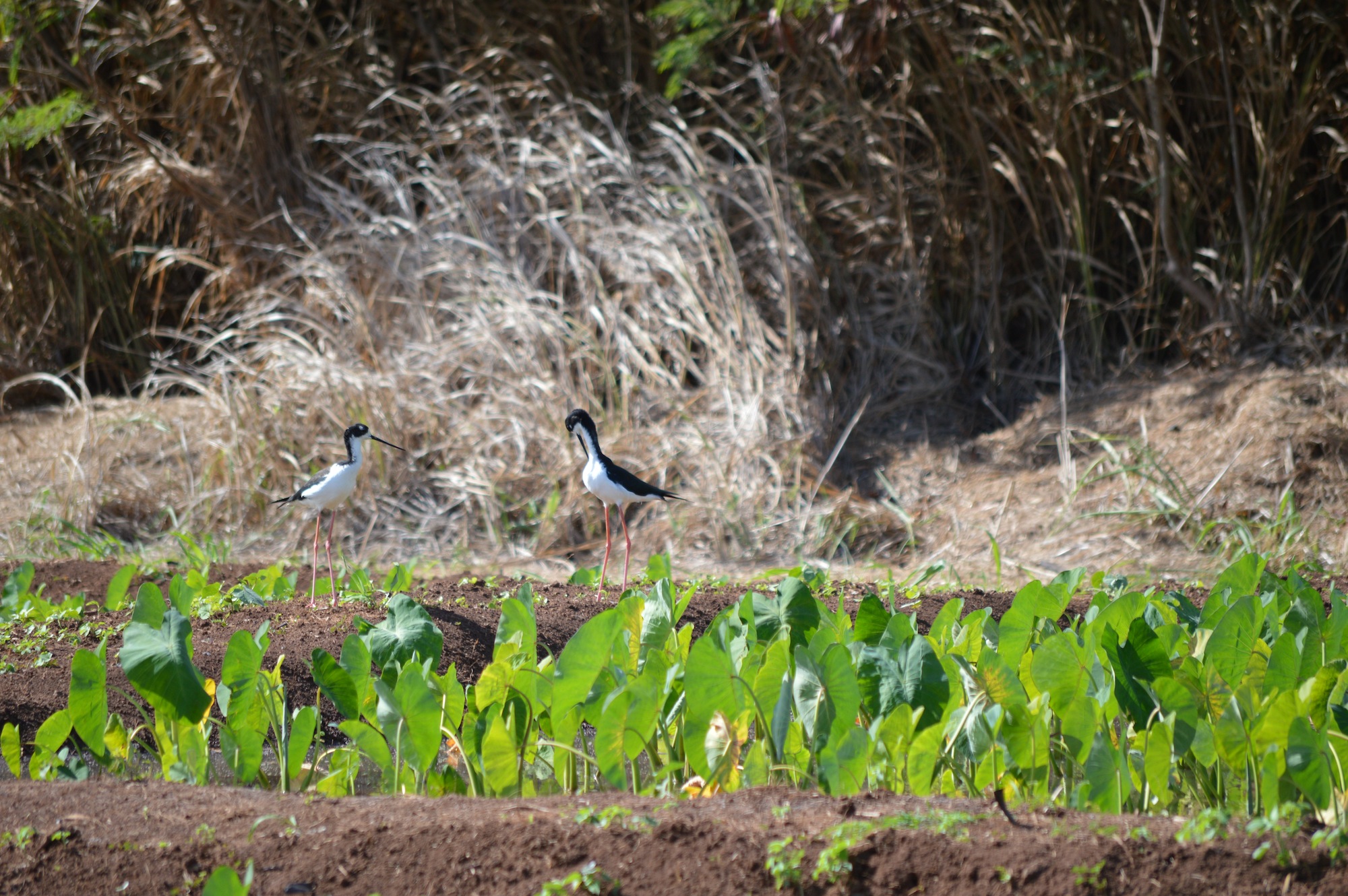
I’ve also been reminded of this lately as our 13 new lo`i pondfields have filled up one by one and become a major new stop-off for our local Hawaiian Stilts and Koloa Ducks, two highly endangered water birds with bones among our fossils. Also stopping by are the endangered state bird, the Nene, one of the first examples of a successfully “rewilded” species in the U.S. It occurs as a common fossil in the cave deposits, but was extinct historically on Kaua`i. When released in 1982, it spread rapidly on Kaua`i, at least in part because of the absence of the mongoose on the Garden Isle.
In the air over the cave any day, you are likely to see White-tailed Tropic Birds, which have nested successfully in the west wall of the sinkhole for many years, as attested by the pile of their bones on a high ledge beneath their favorite nest-spot. Coursing up and down the beach, watch, too, for two species of boobies, as well as the Black Noddy flying by, and the local sandpiper, the Wandering Tattler – all creatures of our sediments, but also our present-day skies and beaches.
And everywhere, even the most casual birder can see — from inside the sinkhole to the dry or flooded lo`i, to any opening in the growing forests of our restorations — that great jet-setter of our winter birds, the Kolea, or Pacific Golden Plover, summering and breeding in Canada and Alaska, and enjoying the mild Kaua`i winter with us. Their abundant bones in the sediments of the cave serve to remind us that the Kolea’s vacation route has apparently not changed for thousands of years.
This is a great article, Dr. Burney. The living aspects of cave restoration provide a vibrant template to imagine its past.
Well said.
I have also regularly seen ruddy turnstones in the area. What about wedge-tailed shearwaters? They used to nest just down the coast.
What and where are the lo’i pondfields, Dr. Burney?