
This is no belated Halloween joke. I mentioned in the last issue of the newsletter that I was going to National Geographic in October for a meeting that was, well, kind of “secret.” The Long Now Foundation and National Geographic sponsored a closed-doors meeting of scientists, ethicists, even attorneys, to discuss what sounds on the surface like a preposterous notion, that scientists may be on the brink of bringing an extinct species back to life.
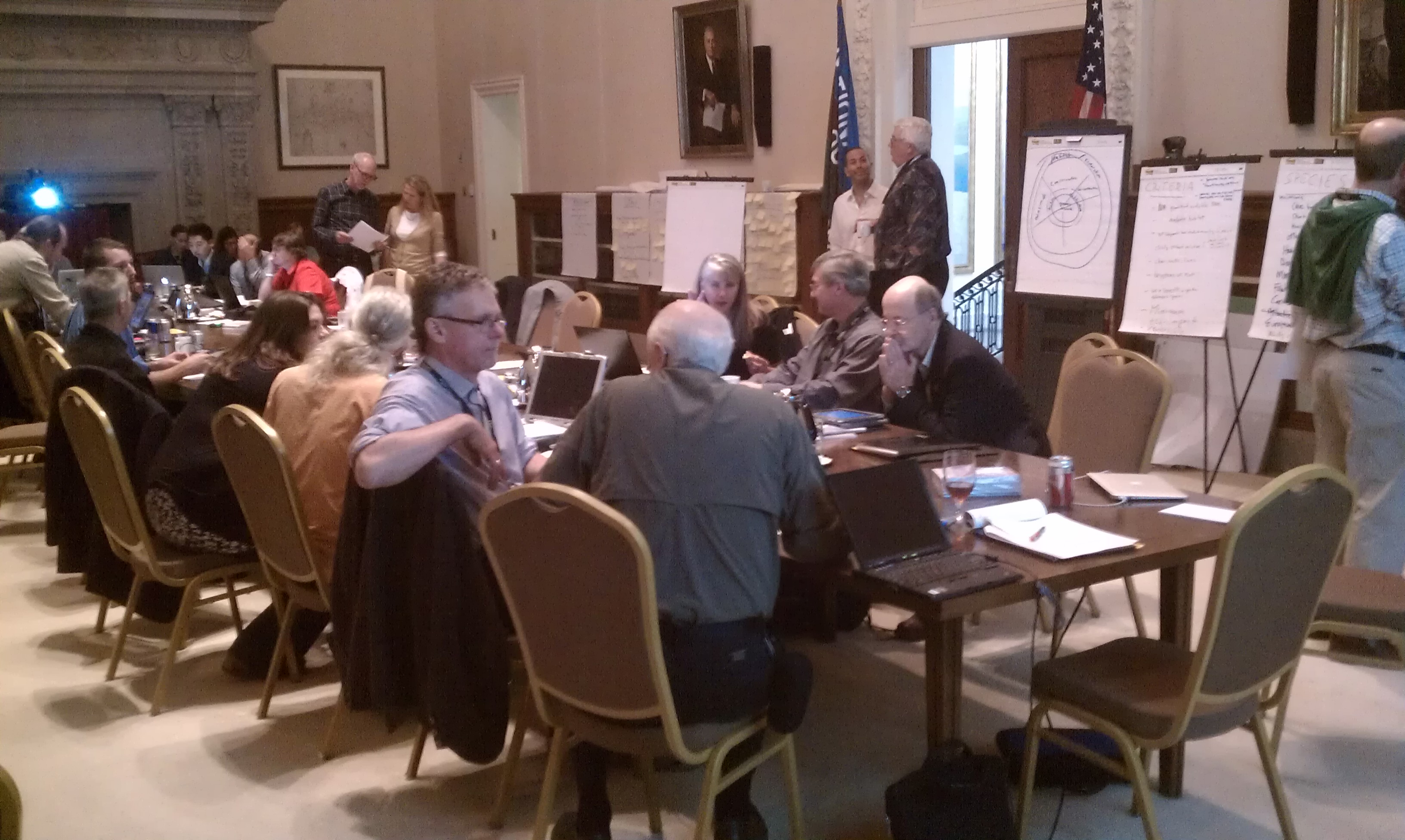
The workshop: “Forward to the Past: De-extinction projects, techniques, and ethics” met in the venerable Hubbard Hall at National Geographic in Washington DC.
But actually, it’s already been done. The result, a lamb cloned from cells of the extinct bucardo, or Pyrenean ibex over two years after the last one died, only lived seven minutes after birth. But as visionary Harvard geneticist George Church quipped, the first airplane flight lasted 12 seconds. In any case, scientists around the world seem to be poised for even more remarkable feats of “resurrection“ from the Passenger Pigeon to the Wooly Mammoth.
For full details, check out the forthcoming April issue of National Geographic magazine. Meanwhile, you can get a sneak peek at the awesome possibilities at the “Revive and Restore” website page on the meeting, here.
Genetics has made some remarkable leaps in the last several months, and one area that interests me in particular, ancient DNA research, has now sequenced much if not all of the genome of several extinct species. Some museum specimens of the thylacine (Tasmanian “wolf” or “tiger”) for instance, have remarkably intact DNA. Fossils frozen or pickled – from Siberian permafrost to the powerful preservation capability of lake-in-cave sites like Makauwahi, hold out the hope that a species may in a sense not be fully extinct if its genome can still be determined.
Anyway, it’s enough to make me wish I had paid more attention in genetics class… but then when I took genetics they still weren’t sure what this DNA stuff was for… In any case, although the meeting was understandably heavy on geneticists and molecular biologists, a few of us, like Sergey Zimov of “Pleistocene Park” fame (see pp. 159-160 in Back to the Future in the Caves of Kauai), and several Dutchmen who are helping rewild at least 10 sites in Europe with wild cattle, horses, and bison, were invited to talk about how all this might (or might not) be related to ecological restoration. I gave a talk about Makauwahi Cave Reserve and other rewilding projects, including the challenges and rewards of growing native Hawaiian species that are almost extinct, and the unexpected ecological surrogacy provided by our tortoises. The group is very interested in the possibility of bringing back some extinct Hawaiian birds and plants.
In any case, you haven’t heard the last of this, I’m fairly sure. One of the visionaries behind this “Revive and Restore” idea is somebody well-known to the Woodstock Generation, Stewart Brand of The Whole Earth Catalog and more recently The Whole Earth Discipline and many futuristic projects. I am still pondering a lot of new things I heard at this meeting — potentially earth-shaking things in the biological realm — and grateful to the Long Now Foundation and National Geographic for inviting me along for the ride.